Meaning of Flanges: What SO Flange Means and How Slip-On Flanges Work
Short answer: the meaning of flanges is simple: flanges are mechanical rims or collars used to connect pipes, valves, pumps, pressure vessels, instruments, filters, and equipment with bolts and a gasket. In piping, a flange creates a removable joint that can be assembled, inspected, cleaned, repaired, or replaced without cutting the pipe.
One common abbreviation buyers see is SO flange. SO means slip-on flange. This flange slides over the pipe and is then welded, usually with fillet welds on both the inside and outside. It is popular because alignment is easier than with some butt-welded designs, and the manufacturing cost is often lower for standard low-to-medium service.
What does flange mean in industrial piping?
In industrial piping, a flange is a bolted connection component. It usually works with another flange, a gasket, and a set of bolts and nuts. When the bolts are tightened, the gasket is compressed between the sealing faces, creating a pressure-retaining joint.
| Flange term | Meaning | Why it matters |
|---|---|---|
| Flange face | The sealing surface that contacts the gasket | Controls gasket compression and leakage risk |
| Bolt circle | The diameter on which bolt holes are arranged | Must match the mating flange |
| Bore | The internal opening through the flange | Should match pipe size and flow requirements |
| Pressure class | A pressure-temperature rating system | Helps select safe flange thickness and bolting |
| Material grade | The steel or alloy used for the flange | Determines strength, corrosion resistance, and weldability |
Meaning of SO flange: slip-on flange explained
The meaning of SO flange is slip-on flange. Its bore is slightly larger than the outside diameter of the pipe, allowing the flange to slide into position before welding. After alignment, the installer welds around the pipe at the hub side and commonly also at the inside bore side.
Because the pipe enters the flange rather than being butt welded to a tapered neck, the slip-on flange is generally easier to position during installation. This makes it useful for many water, air, steam, utility, chemical, and general industrial lines where the pressure, temperature, fatigue, and corrosion conditions are within the permitted range of the piping specification.
How a slip-on flange works
- The installer checks the pipe outside diameter, flange bore, facing, and pressure class.
- The SO flange is slipped over the pipe end.
- The flange is aligned with the mating flange, valve, pump, or equipment nozzle.
- Fillet welds are applied according to the project procedure.
- A compatible gasket is placed between the sealing faces.
- Bolts are tightened in a controlled cross pattern to compress the gasket evenly.
Advantages of SO flanges
- Easy alignment: the flange can move along the pipe before welding, which helps field fit-up.
- Lower manufacturing cost: the geometry is simpler than a weld neck flange in many sizes.
- Common availability: ASME, EN, JIS, GOST, and DIN slip-on flanges are widely supplied.
- Useful for standard service: properly welded and installed SO flanges perform well in many low and medium pressure systems.
- Flexible facing options: raised face and flat face slip-on flanges are both common, depending on the mating equipment and gasket.
Limitations of SO flanges
A slip-on flange is not the best answer for every piping system. Compared with a weld neck flange, it has lower resistance to severe cyclic loading because load transfer depends on fillet welds rather than a full tapered hub and butt-welded transition.
Engineers should be cautious when considering SO flanges for high pressure, high temperature, strong vibration, thermal cycling, hazardous media, severe corrosion, hygienic service, or large-diameter lines with high external loads. In these conditions, a weld neck flange, socket weld flange, lap joint flange, or engineered custom flange may be more suitable.
SO flange vs weld neck flange
| Item | SO flange | Weld neck flange |
|---|---|---|
| Connection method | Pipe slips into flange and is fillet welded | Pipe is butt welded to tapered neck |
| Installation | Easier alignment before welding | Requires more accurate fit-up |
| Cost | Often lower for standard service | Usually higher due to hub geometry and welding |
| Strength under cycling | Moderate, depends on service and weld quality | Better for severe pressure and temperature cycling |
| Typical applications | Utility and general process lines | Critical, high-pressure, high-temperature, or hazardous lines |
How to specify an SO flange correctly
When sending an RFQ to a flange manufacturer, avoid writing only “SO flange.” A complete request should include:
- Standard and edition, such as ASME B16.5, ASME B16.47, EN 1092-1, JIS B2220, GOST 33259, or DIN.
- Nominal size, pressure class or PN rating, and pipe schedule.
- Material grade, such as ASTM A105, ASTM A182 F304/304L, F316/316L, duplex stainless steel, or alloy steel.
- Facing type, such as raised face, flat face, or special gasket surface.
- Bore requirement and any custom machining tolerance.
- Inspection requirements, including dimensions, PMI, hardness, PT, MT, UT, or material certificates.
- Surface treatment, marking, packing, and destination country.
Common flange abbreviations buyers should know
| Abbreviation | Meaning | Typical description |
|---|---|---|
| SO | Slip-on flange | Slides over the pipe and is fillet welded |
| WN | Weld neck flange | Butt welded to pipe with a tapered hub |
| BL | Blind flange | Closes a pipe end, nozzle, or inspection opening |
| SW | Socket weld flange | Small-bore flange with pipe inserted into a socket |
| TH | Threaded flange | Connects by pipe threads without welding |
| LJ | 搭接法兰 | Used with a stub end and can rotate for bolt alignment |
| RF | Raised face | Common gasket seating surface |
| FF | Flat face | Often used with full-face gaskets and cast equipment |
| RTJ | Ring type joint | Metal ring gasket groove for high-pressure service |
Material selection for SO flanges
Carbon steel slip-on flanges are often used for water, oil, air, and general utility systems. Stainless steel slip-on flanges are selected when corrosion resistance, cleanliness, or low maintenance is important. 304/304L is common for general corrosion resistance, while 316/316L provides better resistance in many chloride-containing environments. Duplex stainless steel may be selected for higher strength and better chloride stress-corrosion resistance.
A professional stainless steel flange supplier should verify chemical composition, heat number, mechanical properties, heat treatment, and final marking. For export projects, material certificates and dimensional reports are often required before shipment.
Installation checks that prevent leakage
- Confirm that the SO flange standard, class, and material match the piping specification.
- Check that the pipe is inserted to the correct position before welding.
- Maintain proper weld size and avoid weld defects at the bore.
- Clean the sealing surface before gasket installation.
- Use the specified gasket, bolts, nuts, washers, and lubricant.
- Tighten bolts in multiple passes using a cross pattern.
- Do not use bolt force to pull severely misaligned piping into position.
Why source slip-on and industrial flanges from SongHai?
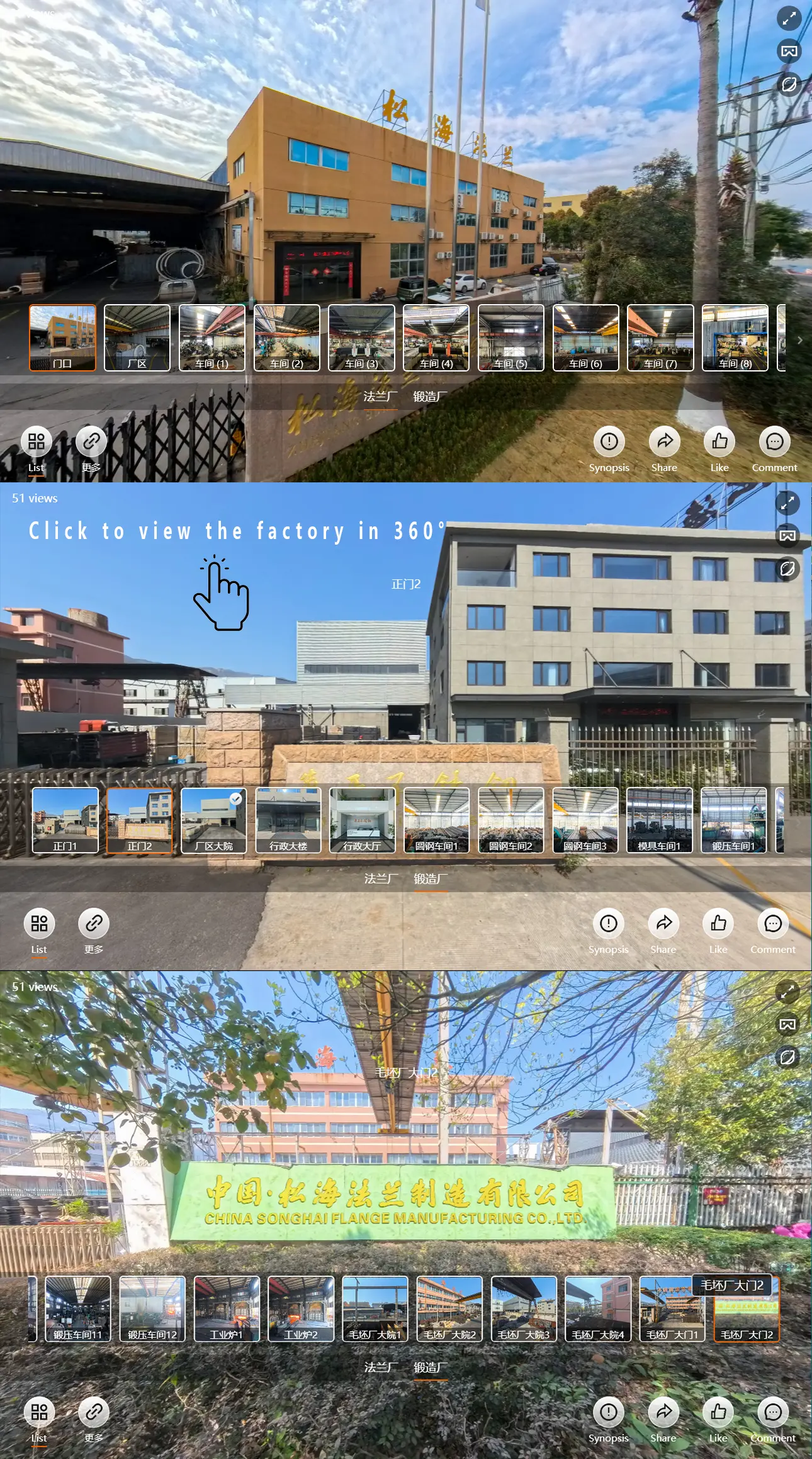
SongHai manufactures stainless steel flanges, slip-on flanges, weld neck flanges, blind flanges, plate flanges, threaded flanges, socket weld flanges, lap joint flanges, pressure vessel flanges, vacuum flanges, instrument flanges, filter flanges, and custom forged flanges. The factory supports standard products and engineered drawings with CNC machining, inspection documentation, traceability, and export packing.
Frequently asked questions
What is the meaning of flanges?
Flanges are bolted connection components used to join pipes, valves, pumps, vessels, and equipment. They allow a piping system to be assembled and dismantled without cutting.
What is the meaning of SO flange?
SO flange means slip-on flange. It slides over the pipe and is welded into place, usually with fillet welds.
Is an SO flange the same as a slip-on flange?
Yes. SO is the common abbreviation for slip-on flange in many piping specifications and flange catalogs.
Where are slip-on flanges commonly used?
They are commonly used in low-to-medium pressure water, air, steam, oil, utility, and general process piping when allowed by the project specification.
When should a weld neck flange be selected instead?
A weld neck flange is usually preferred for high pressure, high temperature, hazardous fluids, strong vibration, thermal cycling, and critical service because of its stronger butt-welded load path.
WhatsApp: +86-18658777855
Email: 1007788887@qq.com