
UNC Fittings Guide: UNC vs UNF Threads, NPT and UNJF
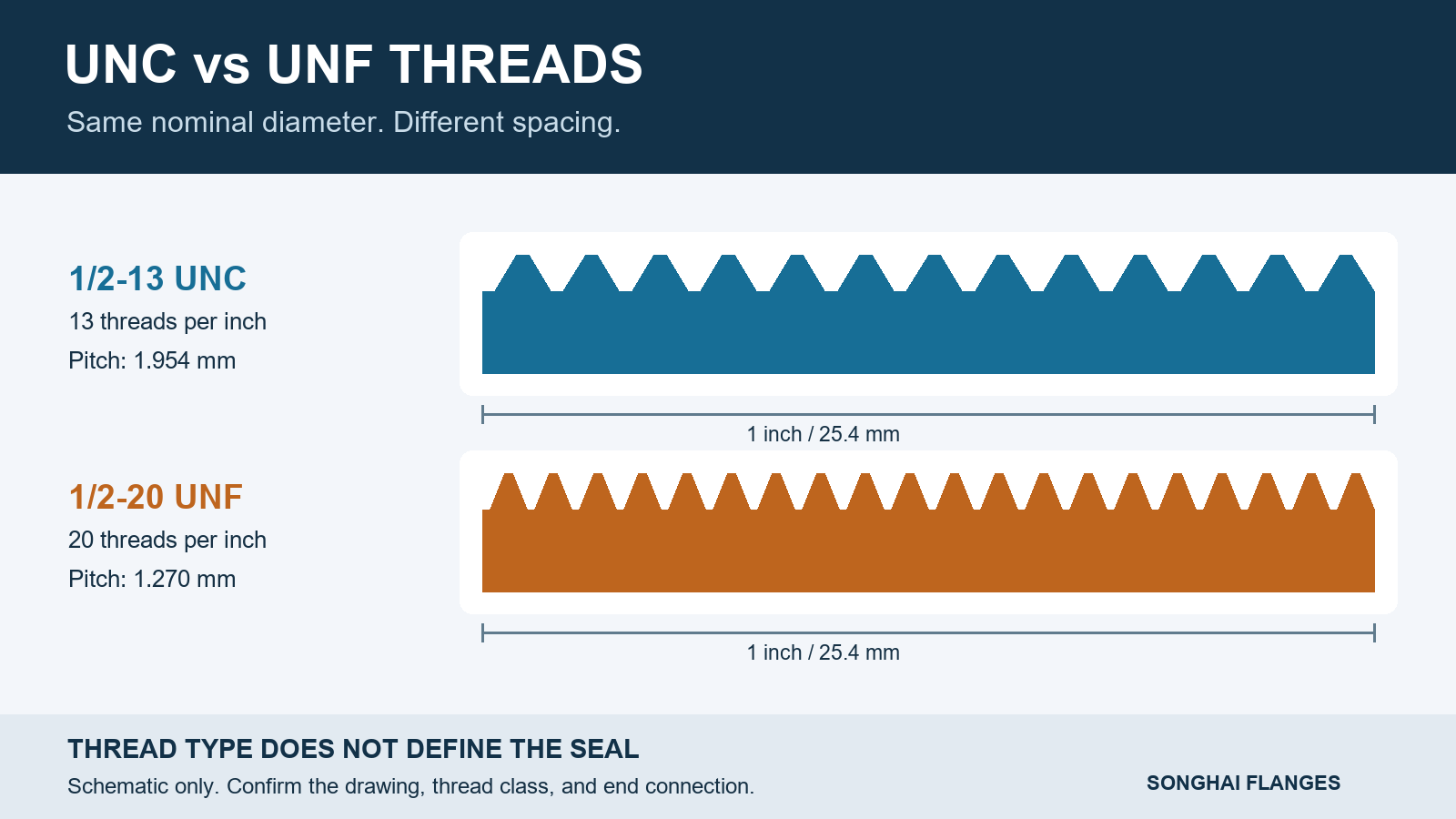
UNC fittings can be an ambiguous purchasing description. UNC identifies a coarse inch thread series; it does not identify a complete hydraulic connection or a pressure seal. Before ordering a replacement, separate three questions: What thread is it? What surface seals the joint? What specification controls the component?
The main difference between UNC vs UNF threads is pitch at the same nominal diameter. UNC has fewer threads per inch; UNF has more. NPT belongs to a different, tapered pipe-thread system, while UNJF adds controlled root geometry to the fine-pitch UNJ thread form. This guide explains those distinctions for flange bolting, fittings, maintenance, and purchasing.
Quick answer: UNC, UNF, NPT, and UNJF
| Designation | Basic meaning | Geometry | What the designation does not tell you |
|---|---|---|---|
| UNC | Unified Coarse, commonly called Unified National Coarse | Straight, coarse series; 60° thread angle | Bolt grade, pressure rating, or sealing design |
| UNF | Unified Fine, commonly called Unified National Fine | Straight, fine series; 60° thread angle | Whether the connection uses a flare, O-ring, or another seal |
| NPT | National Pipe Taper | Tapered pipe thread; 60° thread angle | Compatibility with a same-number inch bolt thread |
| UNJF | Fine-pitch series of the Unified UNJ thread form | Straight thread with controlled external root radius | Permission to substitute ordinary UNF hardware |
Unified inch thread forms, series, classes, and designations are covered by ASME B1.1. NPT dimensions and gaging belong to the separate ASME B1.20.1 pipe-thread standard.
What is UNC in a thread or bolt marking?
The UNC meaning in bolts is the coarse series of unified inch screw threads. For example, 1/2-13 UNC-2A describes an external thread with a nominal major diameter of 1/2 inch, 13 threads per inch, and a Class 2A fit. The corresponding nut normally carries an internal-thread designation such as 1/2-13 UNC-2B.
A UNC bolt is therefore a bolt with that thread series, not a particular strength grade. Two bolts with identical UNC bolt threads may have different materials, heat treatments, coatings, and allowable loads. A purchasing line that says only “1/2 inch UNC bolt” still needs length, material specification, grade, finish, quantity, and any inspection requirements.
In a callout, A identifies an external thread and B an internal thread. Class 2 is common in general industrial hardware; Class 3 has tighter tolerances. A tighter class is not a substitute for specifying a pressure seal. For an overview of series and classes, see the manufacturer guidance from Portland Bolt.
What does UNF stand for, and what is a UNF thread?
UNF stands for Unified National Fine, also described as the Unified Fine thread series. At a given nominal diameter, it has a smaller pitch than UNC. A 1/2-20 UNF thread advances 0.050 inch per revolution for a single-start thread, compared with approximately 0.0769 inch for 1/2-13 UNC.
Fine threads can provide a larger tensile stress area than coarse threads of the same nominal diameter. That does not make every UNF part stronger than every UNC part: material, engagement, manufacturing quality, and loading remain decisive. Likewise, a UNF fitting does not become leak-tight simply because its threads are closely spaced.
UNC vs UNF thread size chart
Use the chart below for preliminary identification. The diameter is the nominal major diameter of the screw thread, not pipe bore or tube outside diameter. Manufacturing tolerances mean a caliper reading need not equal the nominal value exactly.
| Nominal diameter | Diameter, mm | UNC, TPI | UNF, TPI |
|---|---|---|---|
| 1/4 in | 6.350 | 20 | 28 |
| 5/16 in | 7.938 | 18 | 24 |
| 3/8 in | 9.525 | 16 | 24 |
| 7/16 in | 11.113 | 14 | 20 |
| 1/2 in | 12.700 | 13 | 20 |
| 5/8 in | 15.875 | 11 | 18 |
| 3/4 in | 19.050 | 10 | 16 |
| 7/8 in | 22.225 | 9 | 14 |
| 1 in | 25.400 | 8 | 12 |
Calculation: pitch in inches = 1 ÷ TPI; pitch in millimeters = 25.4 ÷ TPI. For 1/2-13 UNC, pitch is approximately 1.954 mm; for 1/2-20 UNF, it is 1.270 mm. Reference: manufacturer thread-pitch chart. This comparison is not a substitute for the applicable dimensional limits or acceptance gauges.
What buyers should mean by “UNC fittings”
A fitting may contain a UNC mounting thread, a custom coarse-thread connection, or a threaded feature unrelated to the fluid passage. Calling the whole item a UNC fitting hides those differences. Ask the supplier to identify the function of each threaded end and provide the full connection drawing.
For example, a mounting bolt might secure a manifold while a separate port carries hydraulic fluid. The mounting bolt’s UNC callout says nothing about the port. Similarly, an adapter may have different connection types at its two ends. Specify both ends individually instead of describing the entire adapter by one thread series.
The search phrase “UN fitting” is also incomplete. UN can refer broadly to unified threads and appears in constant-pitch designations such as 8-UN. A complete order needs diameter, TPI, thread form and class, connection standard, sealing geometry, material, and operating conditions.
UNF vs NPT: the seal is the decisive difference
When comparing UNF vs NPT, check both thread shape and sealing location. Parallel UNF threads usually retain components while a separate interface makes the fluid seal. NPT uses tapered thread engagement, normally with a suitable sealant applied according to the component manufacturer’s instructions.
| Check | UNF-based connection | NPT connection |
|---|---|---|
| Thread shape | Parallel | Tapered |
| Size designation | Screw-thread nominal major diameter and TPI | Nominal pipe size and TPI; nominal size is not measured thread OD |
| Typical sealing interface | Specified O-ring, flare, seat, or other dedicated seal | Tapered thread joint, normally with compatible sealant |
| What to inspect | Thread plus seat angle, O-ring location, and port geometry | Thread form, taper, engagement, and specified sealant procedure |
| Direct interchangeability | No. Use an adapter designed and rated for the two specified connections. | |
A 1/2-20 UNF thread and a 1/2 NPT thread are not the same diameter–pitch combination. Even two connections with matching straight threads can have incompatible sealing faces. A 37° flare and a 45° flare must not be treated as interchangeable because their nuts appear to fit.
For connection identification, see Swagelok’s Thread and End Connection Identification Guide. For assembly distinctions between flare, face-seal, and port connections, see Parker’s fitting training resources. Our JIC flare fittings guide provides related background.
UNF vs UNJF: same pitch does not mean the same specification
UNJF is the fine series of the UNJ thread form. Its external thread has a controlled rounded root, and the mating internal geometry provides the required clearance. This geometry matters in fatigue-sensitive applications, including specified aerospace hardware. The distinction concerns more than counting threads.
For UNJF vs UNF substitution, follow the drawing and governing specification. Matching nominal diameter and TPI does not demonstrate compliance. Do not assume an ordinary UNF nut is suitable for an external UNJF thread, and do not approve a substitution solely because components turn together by hand.
The Thread Check technical catalog describes UNJF’s controlled root radius. For current unified-thread coverage, consult ASME B1.1; ASME states that the former B1.15 UNJ standard was incorporated into B1.1 in 2019.
UNC measurement: a practical identification sequence
- Start with the drawing or part number. It may already identify a port standard, thread class, or special thread that a quick measurement would miss.
- Clean and inspect the part. Remove contamination without damaging the thread or sealing surface. Worn or deformed threads can give misleading readings.
- Check straight versus tapered geometry. Compare diameter at separated axial positions; do not judge from one measurement alone.
- Measure external major diameter and pitch. Use calipers for approximate diameter and the appropriate pitch gauge for TPI. Internal threads require appropriate measuring and gaging methods.
- Identify the seal separately. Record flare angle, O-ring position, sealing face, and mating port details. Photographs should show the end face as well as the side.
- Verify with the specified gauges. Calipers and a pitch gauge help identify a candidate thread; they do not certify thread class or manufacturing acceptance.
Worked example: a male thread measures close to 12.7 mm in diameter and matches a 20-TPI leaf. That suggests 1/2-20 UNF, but it does not yet identify the seal or confirm the part’s rating. Record the suspected thread, inspect the end connection, and check the manufacturer’s drawing before ordering.
Flange bolts: do not assume every stud is UNC
A flange assembly has separate requirements for the flange, gasket, studs, and nuts. The bolt thread is not the pipe connection thread. Many larger pressure-service studs use the constant-pitch 8-UN series; do not extend a UNC size chart automatically to every flange bolt diameter. Confirm the applicable bolting specification and purchase order.
Also avoid choosing fasteners by thread series alone. A stainless flange does not automatically determine one bolt grade, tightening torque, or coating. Temperature, corrosion exposure, required preload, lubrication, and gasket behavior all affect the assembly. Use the project’s approved bolting procedure rather than a generic torque value.
For related procurement details, review our flange bolt length guide and high-temperature bolt material guide.
RFQ checklist for UNC fittings, UNF fittings, and bolts
| Item | What to provide | Why it matters |
|---|---|---|
| Thread | Complete callout for every end; male/female and right/left hand | Avoids diameter, pitch, and mating errors |
| Connection | Drawing, standard, seat geometry, and sealing element | Distinguishes mechanical fit from fluid sealing |
| Material | Material specification, grade, coating, and seal compound | Allows service compatibility review |
| Dimensions | Length, engagement, bore or tube size, and installation clearance | Prevents ordering a part that fits the thread but not the assembly |
| Service | Fluid, operating pressure and temperature, and cycling conditions | Supports review of the complete component rating |
| Quality and delivery | Certificates, inspection criteria, quantity, and required delivery | Makes quotations technically comparable |
A useful fastener enquiry might read: “1/2-13 UNC-2A stud, specified overall and threaded lengths, material and grade per project specification, matching 2B nuts, finish and inspection per attached drawing.” For an adapter, add a separate complete connection description for each end and identify the required seal.
Frequently asked questions
What is the UNC bolt meaning?
It means the bolt uses the Unified Coarse inch thread series. UNC alone does not specify strength, material, length, or suitability for a flange joint.
What are UNF threads used for?
UNF threads appear in mechanical fasteners and in specified fluid connection designs. The exact application depends on the component standard; “UNF” alone does not identify a hydraulic fitting.
Can UNC and UNF threads be connected?
Not when their pitches differ. For example, 1/2-13 UNC and 1/2-20 UNF cannot form a correct mating pair. Stop if a connection binds instead of forcing it.
Are fine threads automatically vibration-proof?
No. Fine pitch alone does not prevent loosening. Joint preload, transverse movement, embedment, and the specified locking method must be considered in the joint design.
Can thread tape make a UNF fitting seal?
Thread tape cannot replace a missing O-ring, correct flare seat, or other specified seal. Identify and repair the intended sealing interface using the manufacturer’s procedure.
Is NPT vs UNF just a different way of writing the size?
No. They are different thread systems with different sizing conventions and connection requirements. An engineered adapter may connect the two systems; the threads do not directly interchange.
What does “UNC UNF meaning” tell a buyer?
It distinguishes coarse and fine series within unified inch threads. It is the beginning of the specification, not a complete purchase description.
Specify the connection before requesting a quote
For UNC fittings or UNF fittings, send the full thread callout and a drawing showing how the joint seals. For flange projects, specify the flange and bolting requirements separately. Contact Songhai Flanges with your flange specification, mating-component details, quantities, and drawings for a quotation review.